
Mark O'Connor
Liner Note Series, #2

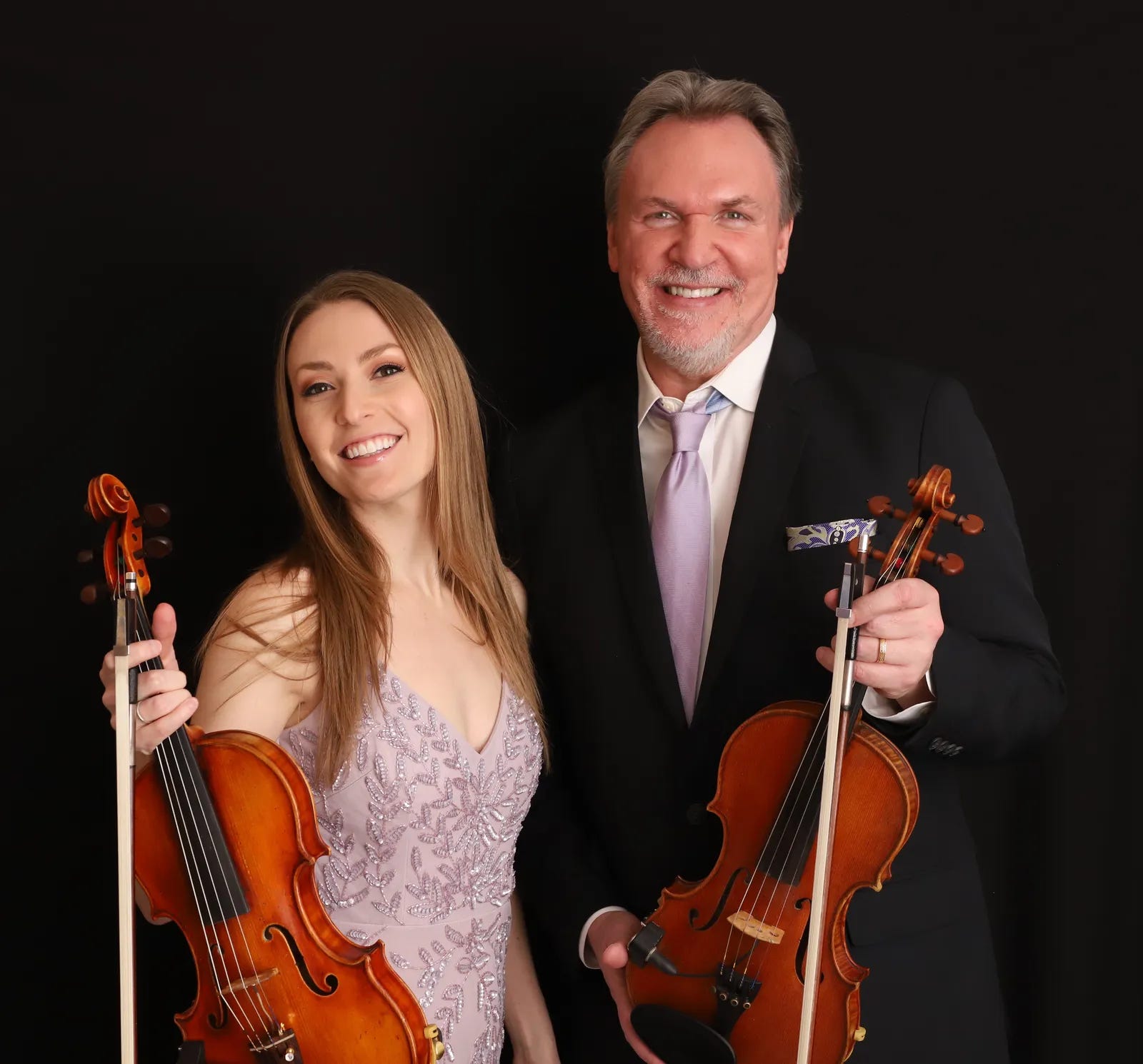
Part 1: The Interview
It was December, sometime in the early Eighties. For those of us at Keyboard, Guitar Player and Frets magazines, that meant it was time for the annual GPI Publications holiday party. This was a gala affair, involving three-course dinners, generous bonuses and rivers of booze, courtesy of munificent publisher Jim Crockett, made even more festive by a jam session that ran sometimes past midnight.
Everybody on staff at these three magazines was at least a competent musician. And most of them had gotten to know artists that they had interviewed. These renowned players were always invited to the festivities; some of them actually showed up and even joined in our performances.
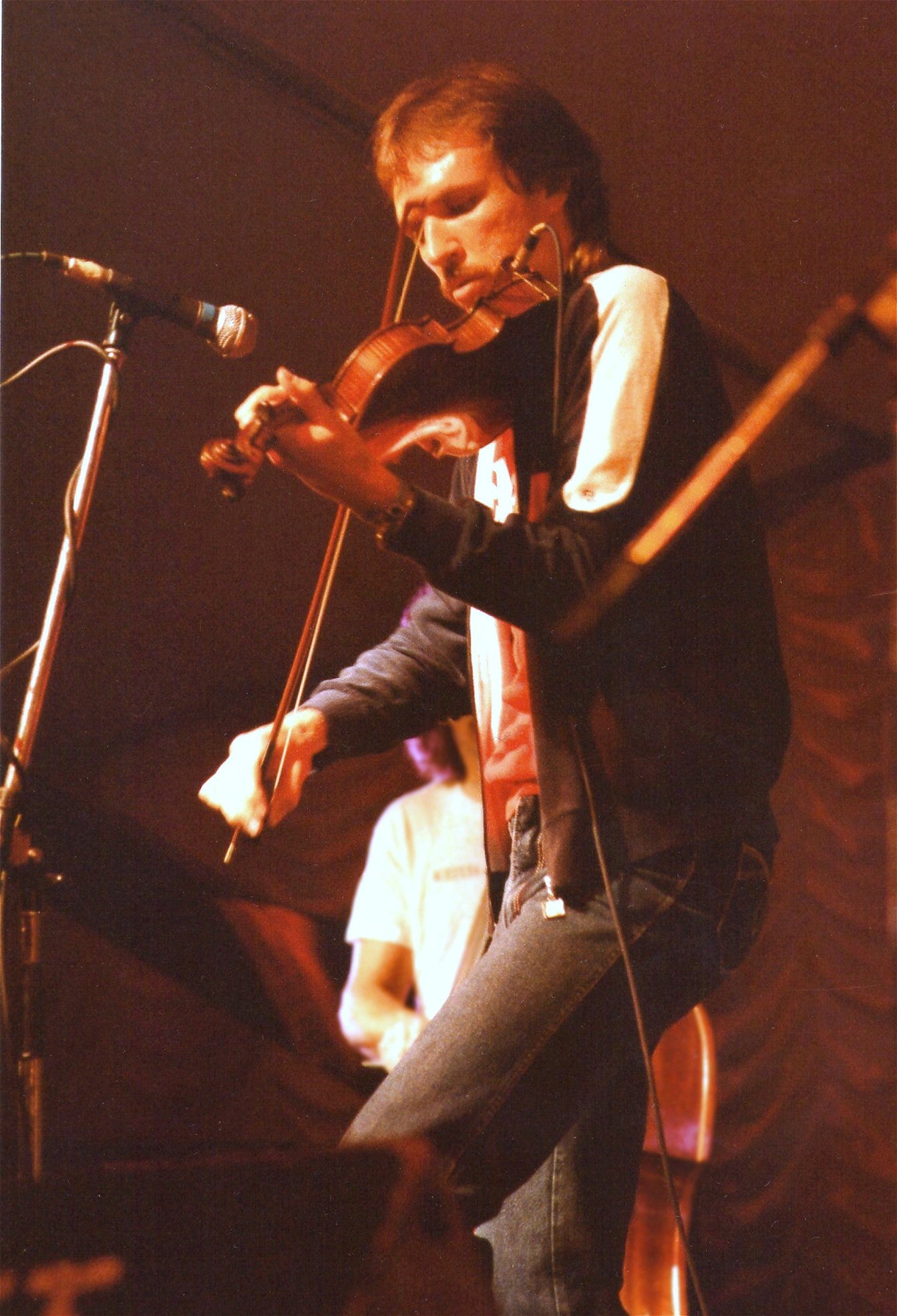
On this particular night I was behind a keyboard with a bunch of editors wielding guitars and most likely Crockett doing his best to lay down a groove on drums. I don’t remember what the song was, but somehow we had generated some momentum by the time it was my turn to solo on a few choruses. I was in the middle of what I hoped would be a sizzling improvisation when I glanced over my left shoulder at one of our guests, a long-haired young fiddler who was riffing on the rhythm, smiling and nodding at me, encouraging me to dig in even more. There’s an image of that moment in my brain, as fresh as if it had happened yesterday.
Later I learned that this guy was named Mark O’Connor. At that time he lived in the Bay Area, over the Golden Gate Bridge in Marin County. Though just twenty years old or so, he had already stirred up a lot of interest in the acoustic music community: Just out of high school, at seventeen, he was selected to replace guitarist Tony Rice in the David Grisman Quintet. I had actually seen him with this group at San Francisco’s Great American Music Hall, where Grisman introduced him onstage with an affectionate humor: “This kid plays everything: guitar, fiddle, mandolin … Actually, he kind of pisses me off.”
He was still in his teens when he landed another gig with the Dregs, known for their sizzling fusion of Southern rock and jazz, began touring with Hot Swing icon Stephane Grappelli, he signed with Rounder Records, debuted at the Grand Ole Opry and won both the annual Grand Masters Fiddle Championships and the National Flat Pick Guitar Championship
Some forty years after we had traded fours at the holiday party, my path again crossed with Mark’s, this time in Nashville. He had not been idle; in fact, he had widened his range even further to include classical composition and two Musician of the Year awards from the Country Music Association. Being intrigued by the Parisian jazz style pioneered by Grappelli and Django Reinhardt, I took special notice of his Hot Swing Trio. With guitarist Frank Vignola and bassist Jon Burr, this group played the classic genre repertoire (“Minor Swing,” “Tiger Rag,” ”Ain’t Misbehavin’”) and tunes written by all three trio members within the parameters of Parisian jazz.
It was kismet, then, when my friend Ellen Pryor, then Mark’s publicist, offered me the opportunity to write liners for their upcoming double-CD set Live in New York, an invitation I couldn’t refuse. I did my usual preparations, which began with listening to the advance music; it was impeccably played, exhilarating as well as faithful to the style. I outlined key points I wanted Mark to address, while leaving space for additional conversation. For further background I researched the genre’s history and characteristics as well as the trio’s biographies. And I spent a few minutes looking back on that holiday party, reconnecting with the energy and enthusiasm I was privileged to feel from O’Connor on the precipice of his unique career.
Which led to our interview, which happened over the phone late in 2004.
****
This isn’t your first swing project. What distinguishes this from the others?
This is the third recording and possibly the final recording of the Hot Swing Trio over a six-year period. It reflects the growth of the group that we were able to build the repertoire from the very beginning, a very specific tribute to Stephane Grappelli and Django Reinhardt, much as the gypsy jazz genre grew through several stages of musical evolution to a place where the Hot Swing Trio took that format to a very broad result encompassing influences of American culture, in the ensemble playing, the improvisation, and the composing.
“There was an aspect in my efforts with the Hot Swing Trio to bring in a chamber music sensibility.”
You’ve done a Hot Swing album every two or three years. During that time you approached the music as an organic, growing thing, rather than as an archival style to which you had to adapt. Why did swing suggest that you could find new interpretive options?
The listener should note that during the entire time of my Hot Swing Trio experiences, I was involved largely with writing classical music. There was an aspect in my efforts with the Hot Swing Trio to bring in a chamber music sensibility. Part of the result of that would easily end up on this recording. Some of the compositional efforts are, as you say, longer in form. They’re far reaching in terms of style and demands on ensemble playing and also parts playing. There’s more reading on this album. I don’t think there was any reading on the first album and then there was quite a bit on this one, so that alone suggests that the music developed very much in a chamber music way.
Yet you play differently within these structures than if you were playing Mozart. Your phrasing comes from swing rather than from chamber quartets.
Right. We don’t forsake any of the great assets that swing jazz brings to the genre. We choose and feature the improvisational aspect of jazz, and we keep the jazz style and manner of playing phrases very much in the idiom, even if we are presented with passages that are largely written out. For instance, “Anniversary” is a good example of bringing in a way to propose a long-form blues piece that would extend the structure of the blues and add odd time signatures and different types of dissonant harmonies through tempo changes, with believing as a player through the entire effort that we are playing blues music. So the composition maybe suggests that a whole different form has been created.
With everybody reading, there must still be extended sections of the score that say “wing it” or “solo.”
Exactly, and because of that it is incumbent on the musicians in the trio to make the reading part jell with the improvisational blues part. It can’t all of a sudden shift gears and say, “Okay, we’re not doing that anymore, we’re doing a completely different thing” and have it be a cohesive piece. We have to play the written part almost in an improvisational, off-the-cuff way. Then we’re also organizing some of our improvisational parts in the way of hitting certain things together, as in certain harmonic chord changes where we will enhance the structure of the piece, even when somebody is improvising.
Jon sticks pretty much to a plucked jazz bass line, which explains in part how you can keep that feel.
He does play a beautiful arco solo on the first number, “Fascinatin’ Rhythm.” He’s an accomplished arco soloist. But with his pizzicato work in this group, because it’s a trio, he defines the rhythmic groove and it’s a very powerful rhythm section between John and Frank. It almost hurts me to not feature it all the time – it’s that good. It’s probably unequalled in string jazz. I could easily say that: It’s a powerhouse duo. For instance, the “M&W Rag”: I’m playing largely a written-out part, which is a long-form rag, and their accompaniment to the rag is beautifully felt and designed with their capabilities of playing rhythm.
Does the word “rag” have a specific meaning in terms of composition?
Ragtime speaks to the style of playing and the swung eighth-notes of the solo playing. Scott Joplin’s work brought it into existence. The rag has since become adopted into American folk music through fiddling. I grew up playing ragtime as the third tune in my contest rounds as a competitor, when I was a kid. So ragtime lends itself well to string jazz. You don’t hear many examples of that, and therefore I felt it was a natural effort for me to come up with a piece that was not only a ragtime piece for this group but to once again to feature the more long-form, chamber music elements of what I’ve been working on with the rest of my career. I combined the notions of jazz string trio, ragtime music, fiddle music from my contest days, and long-form compositions from my classical forays. All that combined ends up with “M&W Rag.”
One of the challenges of writing about this album is that it nods toward a certain genre, yet you’ve done so many other things that it’s hard to talk about your work within the genre because you keep pulling stuff from other genres into it.
It’s a true cross-pollination. Even though Hot Swing Trio is easily the most sincere jazz effort of my entire career, you can’t ignore the fact that there’s so much cross-pollinating going on in the music that it creates its own genre.
From Fiddle to French Swing
You grew up playing Texas fiddle music. When did you first hear swing violin and what was there in it that piqued your curiosity?
I was thirteen when I heard Grappelli, Venuti, and others. There was only a handful of great violin players who would be on a par with Grappelli and Venuti, and they would include Stuff Smith and Eddie South. Those guys were recording in the Twenties, Thirties, and Forties. Those were the jazz violin players that jazz violin enthusiasts listened to. When I was thirteen I also got to see Stephane Grappelli play live, and I was so taken with that experience that I dedicated myself to learn jazz violin at that time.
How did you learn it?
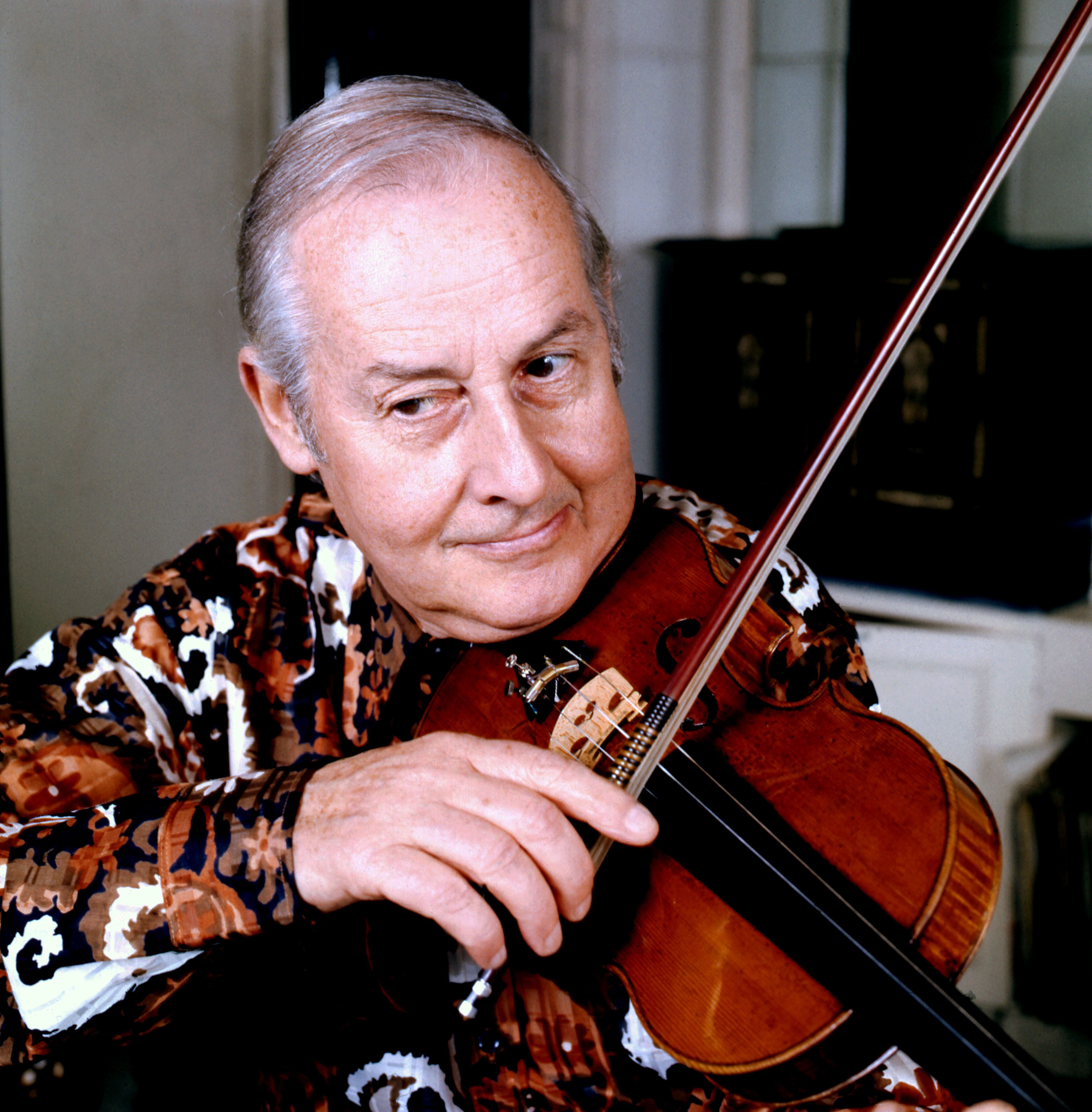
I did a lot of transcribing. I transcribed a lot of Grappelli’s solos and Venuti’s solos as well as the other jazz violinists I liked. Matter of fact, I’ve got early tapes of concerts I gave as a fourteen-year-old, where I would literally verbatim quote Joe Venuti solos onstage, whether it be at the library, some little function at school, or whatever it was. That’s how I learned. I didn’t have a jazz violin teacher until I actually met Stephane Grappelli and began to play with him, when I was seventeen.
How did you meet him?
I auditioned for the role of guitarist on a tour that he was conducting with the David Grisman group. I flew to San Francisco to audition right out of high school. I got the job. That was when I began to become friends with Stephane. He took me under his wing as a violin player. Even though I was principally the guitarist in the group, he would insist on having me play at least one or two violin duets with him on each show.
What did that kind of access give you that you could not have gotten from records alone?
Of course, I could get the note choices off the records, although I was continually developing my jazz playing at that point at age seventeen. I was really able to glean, from up close, the technical and stylistic manners that Stephane used – matters of vibrato, how to slide into different notes, and how to use the bow to better accent a jazz phrase. The mechanics of making the music come alive on a violin were very difficult to get off the recordings. Being around him, I realized how he applied these violin techniques to be able to create this incredible swing violin music that he was able to excel in.
On that duo album that Grappelli cut with Yehudi Menuhin, it was obvious that Menuhin didn’t get the music, perhaps because he was so deep into classical technique that it collided with swing phrasing. You came from almost an opposite perspective, being largely self-taught. Maybe Grappelli, then, was helping to step up certain aspects of your technique for jazz.
To be fair, when Menuhin got interested in Grappelli he was quite an older person, and I was this young teenager. If Menuhin had gotten around Grappelli at age sixteen, Menuhin could have been one of the better jazz players we’ve ever heard. It’s all a matter of access and how and when you access the style of music that you’re looking to accomplish. Menuhin was just trying to accomplish a recording. I was accomplishing a whole other lifestyle. I wanted to be on the road as a professional jazz musician. I wanted to learn the repertoire, not just enough to play at concerts but also to really be known as a jazz player. It’s a different thing. That’s why it’s much easier for me to do collaboration like Menuhin’s effort: I know what it takes to try to adopt new techniques and new styles. It takes a lot of effort.
“I’m not looking for any kind of purity; I’m trying to create another kind of musical taste.”
Whether you’ve done classical chamber music, country fiddle, or swing, there’s also a question of shutting out influences that can distract your focus, as well as absorbing elements of other styles in ways that enhance what you’re doing.
It’s a matter of personal taste. For instance, if I’m playing a Delta blues, and I put in a Texas fiddle lick in there, then all of a sudden I’m not pure – but I’ve professed to try to play the Delta blues. In other words, I’m not looking for any kind of purity; I’m trying to create another kind of musical taste.
You mentioned that this may be the last of the Hot Swing trio albums. Why is that?
I’m moving on to other things. I’m very proud of this album. In my opinion, this is going to be the best of the three albums. Certainly some of my best jazz playing on record and some of my best jazz-oriented compositions are on this album. There’s a tune called “Gypsy Fantastic,” which is a barn burner. I’m proud of this piece because it brings back the gypsy element to the way the groove began with an original composition that’s very different from Grappelli’s efforts, even though you could imagine Grappelli possibly playing that piece: He could be technically good, but it’s evolved stylistically to another place, where it’s not an exact copy of the Reinhardt/Grappelli collaboration. It’s moved on into a slightly new atmosphere, combining gypsy and classical elegance with rip-roaring, almost bluegrass and Eastern music underpinnings.
The violin does tear it up on that track, but on the other hand you balance that with things like “Fiddler Going Home,” a very simple and affecting tune.
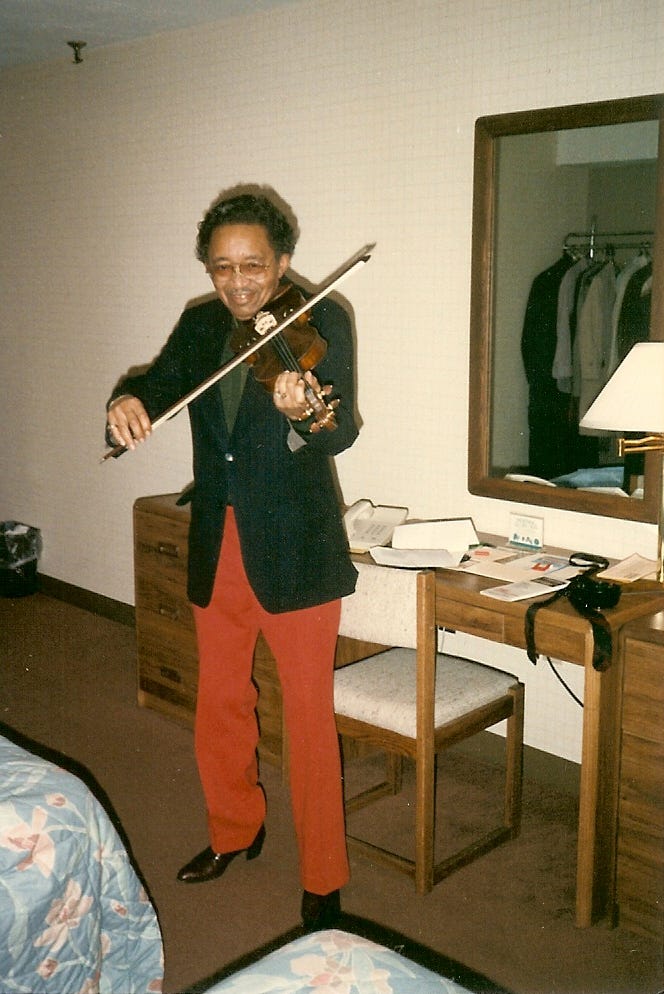
That piece is a tribute – and I’d really like to make this known in the liner notes – to Claude “Fiddler” Williams, one of the great American jazz and blues players. Over the course of our Fiddle Camps, for the twelve years we’ve had them, Claude has been there, teaching. He died last year, at ninety-six years old. He was an African-American man, originally from Oklahoma, spent most of his life in Kansas City, and played with Count Basie in 1936. He was an absolute gem. I loved him so much. I thanked him so much for his presence at our camp, so young students could be around a legend – a black man who saw incredible racial issues in his time that prevented him from playing certain places and things like that. He overcame all that and kept on playing his fiddle. When he died, it was a memory that I could only capture by writing a ballad. So I wrote “Fiddler Going Home,” “Fiddler” being his nickname. That piece got a big response when we played our Hot Swing concerts this past year. People remark about how that piece affects them.
“Fascinatin’ Rhythm” is the only track on this album that also appears on one of your other records. Why did you bring this back?
Actually, “Tiger Rag” is another track I’ve recorded before, and on the final album it’ll happen in the same sequence but I’m going to give “Tiger Rag” its own track ID. I had to mix them together because the applause overlaps the beginning of “Tiger Rag” because “Don’t Get Around Much Anymore” and “Tiger Rag” are the encores in our concerts. I wanted to feature “Fascinatin’ Rhythm” as an instrumental version because my arrangement of “Fascinatin’ Rhythm” was very clever; I wanted that out there with the vocal version, even though the arrangements are very similar. And “Tiger Rag” is the first duet I ever played with Stephane Grappelli, when I was seventeen, but the arrangement is actually slightly different from the one I played with Stephane, although it’s patterned after his arrangement.
“Ain’t Misbehavin’” and “Cherokee” are very familiar tunes. Those particular arrangements aren’t as complex as “Fasincatin’ Rhythm.” Are those kinds of tracks, then, mainly about the playing?
“Ain’t Misbehavin’” is pretty close to the arrangement I developed [unintelligible] for my Heroes album. If you listen to my Heroes album it actually starts out with [hums an opening figure] – the same kind of thing, where we play slow, and then speed up the tempo in the middle, and then slow again. I had done it with Grappelli, and we had been doing it with Hot Swing at nearly every concert. I don’t think we ever played a concert without playing “Ain’t Misbehavin’.” But we hadn’t recorded it, so I wanted to document our history of performing groups, and I wanted to include “Ain’t Misbehavin’.”
What about “Cherokee”?
That was slightly different. We added that recently, and I made that arrangement up for the previous album, called In Full Swing. But we ran out of not only time but also time on the disc; there wasn’t room to add any more songs. So we didn’t even record “Cherokee.” I had plans to record it with Wynton Marsalis, so I had worked it up and I had also worked up on the improvisational aspects of that piece, so I added it to the Hot Swing repertoire anyway, right after In Full Swing was recorded, even though “Cherokee” was not on that particular recording. Because we had been playing on the road for a couple of years, of course I wanted to include it in this set.
“Funky Swing” is one of your compositions. It has a straight-ahead feel too, but there are also some unusual changes and rhythm stops.
“Funky Swing” was done originally as a little piece for the Sony Arcade for kids to come by and interact with the Hot Swing Trio on the computer screen. It is my understanding that up to a million children have heard and seen this “Funky Swing” song at the Sony Arcade in New York City. I wanted to make a bigger production out of the piece, put it in our concert, and record it for this album. The harmonic changes are very modern. It’s easily the most modern piece, harmonically, on the album. It also has a different kind of sentiment to it. It’s a very unusual piece. It combines a couple of different aspects of our musical appetite in that there’s some playful counterpoint crafted into the head of the tune, and then it’s got this modern, almost advanced, harmonic chord progression to solo over in the main body of the tune.
The Hot Swing Trio Legacy
People perceive swing as an archival style that can be identified with a specific part of the past. But if this is the farewell album of the Hot Swing Trio, you’re making your final statement here that the style is actually open to contemporary influences and other players might take it in even more adventurous directions in years to come.
I think so. It could be played up by certain writers that there’s lots of gypsy jazz out there now, which is a wonderful tribute to Reinhardt and Grappelli. I feel in some ways that the Hot Swing Trio brought some of that on through our early success on the concert trail in 1998. Easily, in the last six years, Django-type bands have multiplied a hundredfold. It’s incredible. I’m getting tapes and CDs and videos of guitar players and violin players from all over the world who are playing this. When I began Hot Swing, only six years ago, there was almost none of that going on. That was one of the reasons I assembled this group. Stephane Grappelli, my mentor, had died the year before, and I didn’t want his music to die, so I thought that as an aspect of my career I could help out my teacher’s legacy. That’s why I formed the group. Now, six years later, there’s no danger of this musical style disappearing.
It’s an exuberant, joyful style. It’s melodic and accessible. And it’s fun to play and to hear.
You’re right. It is a lot of fun, but it was also a lot of fun in the eighties and the seventies and the sixties and fifties, but the fact is that very few people were playing it. When Django Reinhardt came to America in the fifties, he could barely get a gig. I think Duke Ellington added him into his big band for a while, but he died kind of penniless. Grappelli’s career was resurrected brilliantly with some very key concerts that put him back on the map, and he became one of the world’s best known violin players. It was awesome, when he died in 1997, that there were so few violinists making a career with that music. Hot Swing maybe acted as a catalyst for other people to go, “Yes, we want to do this too. We want to be a part of this.”
There were jazz violinists …
Of course, there was Jean-Luc Ponty, but even Didier Lockwood, who was more electric bebop, has done a lot to transfer to more of an acoustic string jazz career.
Should I refer to this being possibly the last of the Hot Trio albums?
Well, we could maybe put it into the context that it rounds out an artistic three-album effort in this brief evolution, sort of being ambiguous about the future.
Anything else?
I always like to mention that Jon Burr played with Stephane Grappelli for twelve years, so between that and his six years with me, he has played bass in this music for eighteen years at those levels, which is extraordinary. That’s a unique contribution in this music and John should be credited with that. Frank is one of the greatest virtuosos we have playing guitar. Between Frank’s playing and that of Django and even that of all of the people who pattern themselves after Django today, Frank is very much a modern jazz musician. There’s a connotation about “gypsy jazz.” Gypsy jazz is fundamentally rooted in kind of a folk culture. What’s interesting about our group is that I’m the one who’s rooted in folk culture; Frank and John are very much rooted in modern jazz culture. They can spell out harmonies, chord progressions, and substitutions like any professor at Berkeley. That’s what distinguishes them from most “gypsy jazz” ensembles. It happens that they perform with the ferociousness of any gypsy out there.
They’ve got the spirit and the chops, which goes back to the idea that this music is a meeting ground for players from all sorts of traditions.
On a personal note, if you wanted to work this in, as far as my effort on the album, I would say that my arrangement of “Fascinatin’ Rhythm” is probably one of my best arrangements of a jazz standard, and my solo in “Cherokee” is probably the best jazz solo I’ve ever taken on a recording. That’s my opinion, but that’s what I’m thinking.
Where was this recorded?
This was recorded at Merkin Hall in New York. It was a live recording. We did it over two nights, and then we played the entire concert one afternoon with no audience. We had three stabs at each song. The album was edited from the best performances of the three occasions.
Did the audience’s presence or absence have an effect?
Oh, yeah. The vast majority of it is from the live appearances. We did that one session with no audience just to make sure we would cover our bases on certain parts. If there was a really hard ensemble part that we didn’t think we might get tight enough on the concert, then it would take the pressure off of us on the final concert to go with reckless abandon and not worry about the little things. That proved to be a very good strategy. It really worked.
It must have been hard for the audience not to applaud after solos.
I know [laughs]. We were able to get the good acoustic sound and the distance mikes that way. A lot of our pickups on this album were from overhead mikes that were seven or eight feet away.
The liner notes derived from this conversation will follow shortly, with annotations.