
Mark O'Connor
Liner Note Series, #3

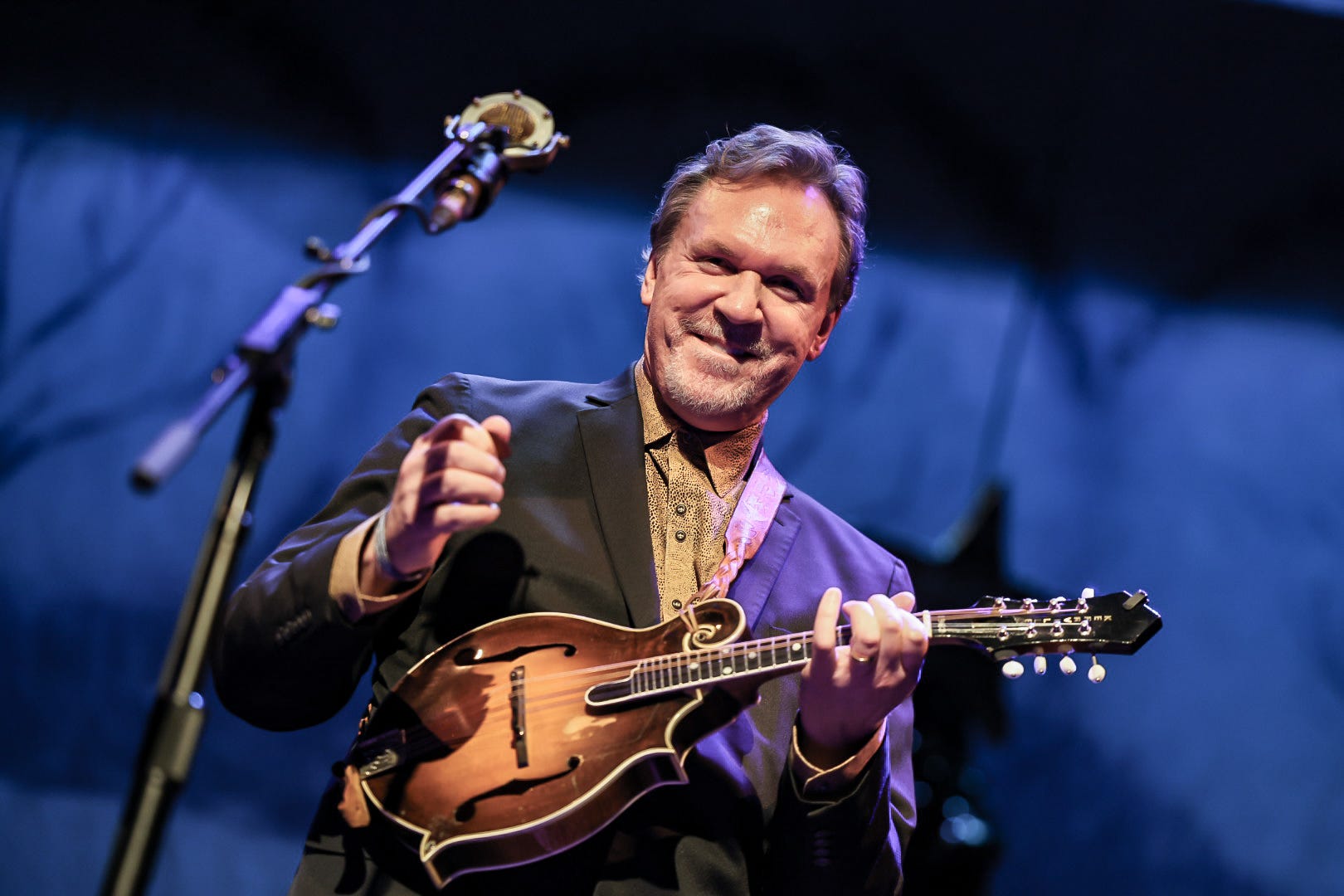
How does a writer get assigned to write liner notes for a new album? I’m not sure how it works, but I assume the artist suggests somebody or, more likely, joins management, publicists, maybe an augur or two, in reaching a consensus. Once that’s done, my experience is that the publicist contacts whoever got the gig and makes the arrangements. Key points, from the writer’s perspective, are, as with all things journalistic, what is the deadline and how much will I be paid? After that come the logistics: getting hold of advance music, getting access to the artist and maybe other participants in the recording, etc.
As I mentioned in my previous Mark O’Connor post, I benefitted in this assignment from knowing Mark, or at least having seen him perform for years. Just as important was the fact that his publicist, Ellen Pryor, wasn’t just ridiculously good at her job, she was and is a close friend, one of the first people I was lucky enough to meet after moving to Nashville. We still see each other now and then, usually when I’m visiting the Frist Art Museum, where she serves as “senior advisor for public engagement.” We’ll talk briefly about whatever the current exhibition is, reminisce about musicians we’ve known and, bizarrely, gossip about professional wrestling, for which we both maintain an inexplicable enthusiasm.
Surmounting even that, though, is Mark’s acute intelligence and curiosity. Given the extraordinary breadth of his music, he has a rare ability to put everything he does into a context that few of his peers achieve. I suspect he also spent some time thinking about what he wanted the liners to say, given the clarity with which he presented these preferences.
For example, my first question to him in our interview was what distinguished his upcoming album from his earlier forays into Parisian swing. In the first sentence of his reply, he indicated that Live in New York was “possibly the final recording” he would make with his Hot Swing Trio. This brought a higher level of importance to questions about repertoire, recording methods … really, every aspect of memorializing this possible farewell to the genre. One didn’t need psychic ability to get the message and structure the conversation so that the results would be what he and I wanted and the project deserved.
The same can be said about interviewing someone for the PR bio that would accompany an album release. The major difference between these two assignments, though, is that bio writers almost always exclude any reference to themselves. Their job is to kindle interest anonymously. On the other hand, the identity of the person writing liner notes is critical. Ideally, he or she would be well known as an expert in some aspect of the music being featured on the album. Thus, two renowned jazz journalists, Leonard Feather and Stanley Dance, shared the first Grammy awarded for their essays on The Ellington Era in 1964. Later winners and nominees included other jazz masters such as Ralph Gleason, Dan Morgenstern and Gary Giddins, Pulitzer Prize winning composer Gunther Schuller, legendary folklorist Alan Lomax, classical music critic Irving Kolodin, and no less than Glenn Gould.
While I’m not so presumptuous as to claim a niche in this pantheon, Ellen and Mark apparently considered me qualified to tackle this assignment. I remain grateful for their trust and happy to follow my interview transcript, posted a few days ago, with these notes it inspired.
****
There are specialists and there are generalists, in music as in life.
Then there is Mark O’Connor, one of those few who somehow play both roles at once.
From his childhood performances as a prodigy in Texas traditional fiddling through his conquest of mainstream country in Nashville’s competitive country music scene and more recently to his emergence as a modern classical composer and performer, O’Connor demonstrates repeatedly his almost unique ability to get to the heart of one demanding musical language after another.
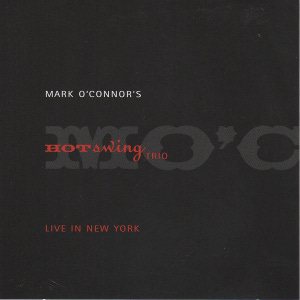
It’s essential to keep this in mind while assessing O’Connor’s performance on Live in New York. This is the third in a series of recordings by his Hot Swing Trio – and likely the last, at least for the time being, but we’ll address this shortly. What’s more to the point is that this is his definitive statement in the style introduced more than half a century ago by the archetypal “gypsy jazz” fiddler Stephane Grappelli. Live in New York, then, is an homage, an original statement, and more than that a gift to those waiting to make their contributions.
More than that, it also makes clear that O’Connor has achieved an insight into this genre that’s comparable to Grappelli’s. He was thirteen when he first heard the master, playing with guitarist Django Reinhardt on the records that documented their marriage of Romany folk music and American jazz. Shortly after that O’Connor attended a Grappelli concert. Exuberant, rhythmically irresistible, romantic, sometimes sentimental, and always technically demanding, the music thrilled the young violinist, who immediately began transcribing the essential recordings. Within a year O’Connor was playing recitals that featured precise, note-for-note renditions of solos by Grappelli and other swinging jazz violinists, whose names he had discovered in his research: Joe Venuti, Stuff Smith, Eddie South …
All of this he accomplished on his own; he would have no teacher until the opportunity arose to work with Grappelli himself. When mandolin innovator David Grisman got the call to accompany the legendary violinist on an upcoming tour, O’Connor, just seventeen, flew from Seattle to San Francisco to audition for and secure the vacant guitar gig in Grisman’s band. “Even though I was principally the guitarist in the group,” he says, “Stephane took me under his wing and would insist on having me play at least one or two violin duets with him on each show.”
Playing side by side with Grappelli, his inspiration and now his mentor, was a transformative experience. “I was able to glean, from up close, the technical and stylistic elements of Stephane’s playing – matters of vibrato, of how to slide into notes, and how to use the bow to better accent a jazz phrase. The mechanics of making the music come alive on the violin were very difficult to get from the recordings. Being around him, it became much clearer to me how he applied violin technique to create this incredible music.”
Through the years O’Connor’s love for “hot swing” only intensified, to the point that he put his own group together to explore and – more significantly – extend the possibilities suggested by this idiom. The Hot Swing Trio – O’Connor, guitarist Frank Vignola, and bassist Jon Burr – released their first CD, Hot Swing!, in 2001, then followed with In Full Swing in 2003. It was a remarkable balance of talents: Vignola and Burr each possess deep jazz credentials, which in Burr’s case included a twelve-year run in Grappelli’s band. With O’Connor’s background in traditional, folk-oriented music, the two critical elements were present in the mix, and when stirred together with high doses of virtuosity and fluid improvisation, they yielded a flavor all their own …
… which is, ultimately, the real point of Hot Swing, the band as well as the style. “We began as a specific tribute to Stephane Grappelli and Django Reinhardt,” O’Connor explains. “Then we built on that, much as ‘gypsy jazz’ grew through several stages of evolution, until we reached the broad range represented on Live in New York, encompassing influences of American culture in our ensemble playing, improvising, and composition.”
In other words, O’Connor’s premise from the start was that this form of music, though associated with a specific time and place in history, is alive and open to growth. The same can be said, of course, about any type of music, as O’Connor has demonstrated in many other projects. It’s his practice to respect the borders that define the limits of every genre – and then to freely cross those borders, bringing with him gifts whose effect is to enrich the way we interpret and hear music in general.
“During all of my Hot Swing Trio exercises I was involved largely with writing classical music,” he points out. “This brought an aspect of a chamber music sensibility to my efforts with the trio, which you can hear very clearly on Live in New York. Some of the compositions reach pretty far in terms of style and the demands of ensemble and parts performance. ‘Anniversary’ is a good example, in that it extends the structure of the blues, adds odd time signatures and dissonant harmonies, changes tempos – yet through the entire effort we were essentially playing the blues. The structure and the spirit of improvisation affect each other, so that we have to play the written parts in an almost off-the-cuff way while also organizing some of our improvisations to hit certain harmonies together, for example, to enhance the structure. It’s like creating an entirely different form.”
Having accomplished all this – reviving a once overlooked style and demonstrating its undiminished vitality – O’Connor admits to feeling that familiar urge to seek past new horizons. Live in New York documents this moment of arrival and departure: Recorded impeccably, executed flawlessly, it completes the trilogy that had begun with Hot Swing! and Full Swing. Just as important, it reminds us that wherever his muse leads him in years to come, O’Connor will astonish and then move on once more, to enrich whatever music he encounters with lessons learned along the way.
Robert L. Doerschuk is a former editor of Musician magazine and author of several books on music.
####