
Preservation Hall
Liner Note Series, #1

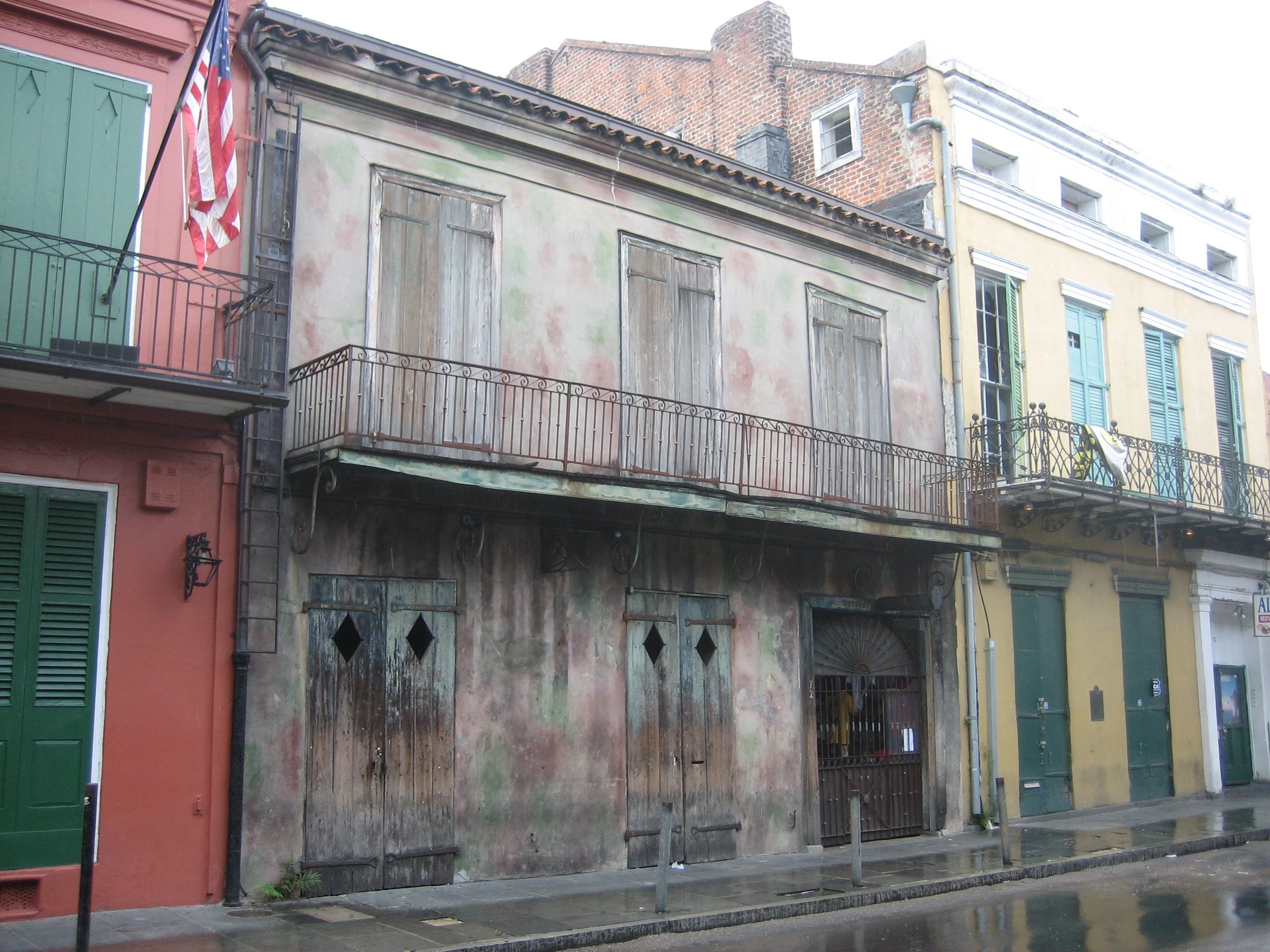
If I had six fingers, I’d probably be able to count all of my life’s experiences that took me to a peak of exultation. Several – not all of them – involved music. (Now that I think about it, maybe seven fingers is a safer estimation.) But some of them definitely did, including one night in New Orleans.
What the Ryman Auditorium is to country music, that’s what Preservation Hall means in the world of traditional jazz. As years passed since the 1920s, each new generation of jazz players stepped a little further away from the roots of the music. The decades whooshed by, bringing the big bands of the Thirties into the Forties, the beboppers from the Forties into the Fifties and on through transformations too numerous to list. Younger musicians usually expressed veneration for those who had preceded them. Some did not: Louis Armstrong famously dismissed the bop innovators for playing “weird chords which don’t mean nothing.” And years later, Keith Jarrett got more specific, not just calling out the young neo-traditionalists as a whole but naming names.
“I’ve never heard anything Wynton [Marsalis] played sound like it meant anything at all,” he told The New York Times. “Wynton has no voice and no presence. … He plays things really, really, really badly that you cannot screw up unless you are a bad player. … He’s jazzy the same way someone who drives a BMW is sporty.”
Amidst this flurry of brickbats and, to be fair, reverence, this little, kind of dumpy venue on Saint Peter Street in the French Quarter kept chugging along, not worrying about Chinese chords or anything else except preserving the earliest forms of jazz as purely as possible. Preservation Hall has pursued its mission for some 65 years now. When it opened in 1961, musicians who actually witnessed the nascence of this genre: Sweet Emma Barrett had played piano in the early Twenties with trumpeter Papa Celestin’s band. At that same time, Willie Humphrey was playing trumpet with jazz pioneers King Oliver and Paul Barbarin. And pianist Billie Pierce was accompanying blues singers Ida Cox and, evidence suggests, the legendary Ma Rainey.
Inevitably, the old guard gave way to players who they had mentored, who hadn’t yet been born when Armstrong, Oliver and Jelly Roll Morton were piecing together the foundations of jazz. This process continues up to the present. Those who sit onstage and play the classic repertoire – “Bourbon Street Parade,” “Basin Street Blues,” “Milneburg Joys,” the bawdy “Shake That Thing” as well as “What a Friend We Have in Jesus” – were nurtured as well on Neville Brothers’ funk and hip-hop. Their goal is to protect the essence of the music from too much updating. By all accounts, they’re meeting that challenge.
When the Hall’s director, tuba player Ben Jaffe, called with an assignment to write bios of the band members, I jumped. In the Bay Area, where I lived, I had developed a love for the old music through records I began collecting as a kid and then stoked by playing with colleagues who played it on gigs. It took a couple of years of not quite getting the nuances down before I could approximate the Jelly Roll style on piano well enough to be selected for the Northern California All-Star Band at the annual Sacramento Jazz Festival.
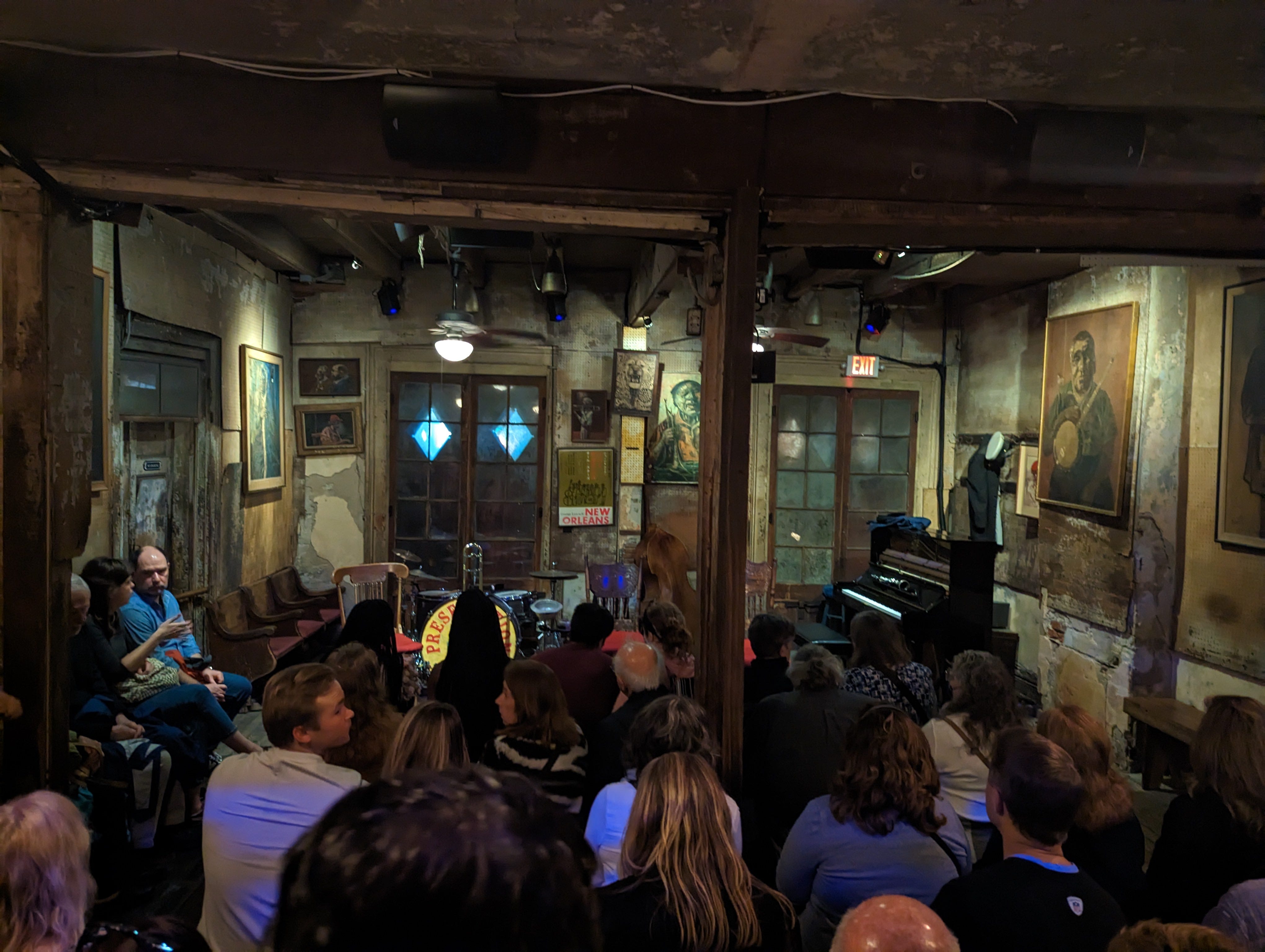
It was a genuine thrill, then, to head down to New Orleans and spend several days just hanging with the band. But that transcendent moment I mentioned above came on one night when the band allowed me to sit in with them. The piano was ancient, a dusty upright that maybe Sweet Emma broke in long ago. But it sounded right and played better than I’d hoped. So I took my seat and asked if we could play “Lady, Be Good,” key of F. Nods all around from the band, who asked me to count the tempo off. And for the next five minutes, I was sailing. At the finish there was cheering, handshakes all around, just a tremendous vibe that I can never forget.
Looking back, though, I do regret one thing: Apparently the band had agreed to let me play the whole set, not just on song. Had I known that at the time, I would positively not have stepped out on the street, where the regular piano player, Rickie Monie, was enjoying a cigarette. “That was great!” I proclaimed, somewhat startling him. “Thanks for letting me sit in.”
Rickie replied, “Sure, but I was kind of getting ready to head home.”
Now, I could have said, “Oh, sure, man! Go ahead!.” But I didn’t, I think because I didn’t want to sound pushy or presumptuous. Who knows? Maybe I’ll finish that set someday.
I didn’t make any tips that night, but there was a bonus in that Ben hired me to write liner notes for two upcoming releases. Both turned out much shorter than some of the stuff I composed on other projects. Generally, the more famous the star is, the less he or she needs someone gushing about their talent. Certain Preservation Hall is famous, albeit within a smaller, select community. In their case, as I understood it, the point was not to recite their history, as hundreds have already done, but to capture a vibe, even if it means doing something I try to avoid: inserting myself into the narrative. But I did, in this brief blurb from one of their 2004 releases::
***
From Shake That Thing, Preservation Hall Recordings
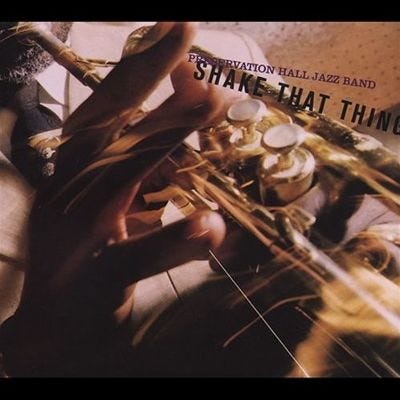
Years ago I had an argument with a friend about the difference between art and science. My point was this: If you could take, say, a squirrel and boost his IQ up to the level of an architect, odds are that the brainy beast would work for pretty much the same goals as his human counterpart: buildings that keep out the elements, don’t fall down, and so on.
What you can’t predict is how the squirrel would perform if someone stuck him behind a piano or planted a horn in his paws. Why? Because music, unlike the practical elements in life, is not scientific -- it’s human.
Unfortunately, much of what passes for music these days could be played by prodigious rodents. Pitch-fixed vocals, robotic tempos, quantized beats -- it’s music by and for lab rats.
All of this is exactly the opposite of what great music should be. The current members of the Preservation Hall Jazz Band may not have thought much about this, but it’s true: The rough edges of their rhythms, the quiver and shout of their vocals, and the swoop and soar of their horns are exquisitely human. On “Eh La Ba” they celebrate simply because celebrating feels good; on “Closer Walk With Thee” they consider the inevitable with a sweet and stately dignity; on “Shake That Thing” they not only let it all hang out -- they practically wave it in your face, with a low-down bonhomie that not even the most prudish among us can resist.
It is, in other words, irrational -- beautifully, humanly irrational. The twenty-one musicians on this disc, who comprised the full membership of the band when they recorded these sides in Preservation Hall itself back in 2001, aren’t just great players; they’re men who have battled and scrapped and learned to love being alive, some of them for a few years, others for a lifetime already. Listening to Shake That Thing makes us feel nearly as fine as it must feel for these guys to have played it.
What about my friend who still doesn’t get the point? I trust that someday he’ll understand that Shake That Thing is what music should be about and maybe someday, again, will be. Until then, to him and all the other squirrely artists out there, I say: Nuts.
****
So that was me, hoping to be clever. My hunch is that the word “squirrel” popped into my head. When an unexpected visitor appears, I figure there’s usually a reason for it. Out of curiosity, then, I probably just started typing, and there it was, right down the last word.
Then there’s this one, also from 2004. It’s different here because it’s an anthology, which demands some perspective, some sense of past to present, by which we hope to emphasize this music’s, this band’s, significance.
From The Best of the Early Years, Preservation Hall Recordings
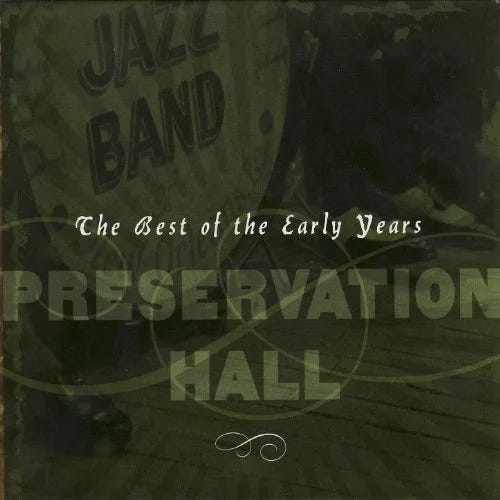
Their names roll by like a mythic litany: Slow Drag, Sing, Kid Sheik, Sweet Emma. Their sound seems to descend from somewhere above, where those who once struggled with life can now lay down their arms, pick up their horns, and blow through happy eternity. Yet their music, on Best of the Early Years is as real as a memory, immediate and alive.
In 1961 Preservation Hall opened on the site of Larry Borenstein’s Associated Artists gallery. Its purpose was to provide sanctuary and a place to play for the many musicians who were still around yet whose roots reached back to the first days of jazz. The success of this endeavor exceeded the expectations of its founders, Allan and Sandra Jaffe; within just a few years it became a beacon that drew lovers of this music from around the world and, in turn, pointed the way for these musicians toward concert halls throughout Europe, Japan, the Soviet Union, and beyond.
Through this institution thousands of listeners would experience a direct connection to the progenitors of jazz, under whose tutelage these survivors had apprenticed: Buddy Bolden, Fate Marable, King Oliver, Freddie Keppard, Bunk Johnson, Baby Dodds, Papa Celestin … the Paul Bunyans and John Henrys of American musical history and legend. It also laid the foundation on which younger players continue to this day to build their own stories. To hear these recordings by the first Preservation Hall luminaries, then, is to be reminded of how much we are in their debt. And for those who haven’t heard these performers, Best of the Early Years is even more wondrous: a welcome from long ago into a music that, no matter how much time passes by, can never age or die.
****
Next time, I’ll dig up something from the archive that isn’t so brief. Thanks for reading!